


Nothing is not nothing in Quantum Electrodynamics (QED): even in a perfect vacuum, devoid of all matter and radiation, virtual photons pop out of nowhere and go back to nowhere. The ability to shape such quantum fluctuations of the electromagnetic vacuum by boundaries of various kinds -- mirrors, optical cavities, and photonic structures – is a powerful tool for tailoring QED phenomena. Typically such boundaries are created by classical, macroscopic objects with fixed optical properties. However, striking advances in experimental atomic physics have demonstrated ordered arrays of thousands of atoms can effectively behave as mirrors. Such atomic mirrors manifest the ultimate limits of miniaturization of a reflective boundary, whose optical properties can be controlled in an atom-by-atom manner. While atomic arrays have been emerging as a promising platform for quantum information processing, their ability to shape the quantum vacuum is, as yet, little explored.
A recent paper by UA Physics researchers – Physics graduate student Annyun Das and Physics joint faculty Kanu Sinha – is a first demonstration of how such atomically-controlled media can modify Casimir-Polder forces arising from the quantum vacuum. As a fascinating and fundamental feature of QED, quantum fluctuations can mediate interactions between two neutral objects such as an atom and a medium, leading to Casimir-Polder forces (literally, forces from nothing!). Atomic arrays open a new regime of QED wherein the electromagnetic vacuum and concomitant quantum fluctuation phenomena can be tailored via the microscopic properties of the boundary. The electromagnetic boundary conditions are thus established actively by the atoms constituting the boundary, instead of being passively imposed. The work asks a fundamental question: what happens to quantum fluctuation forces when the boundary is built atom by atom?
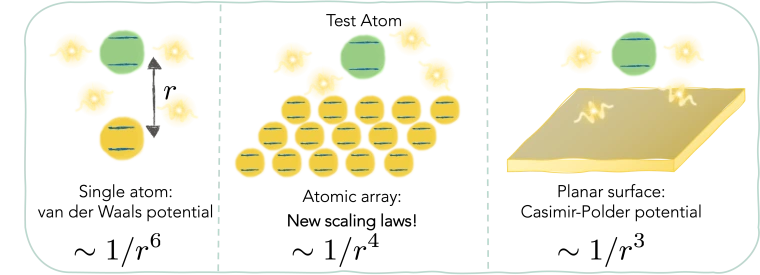
Fig: Fluctuation-induced potential seen by a test atom (green): Atomic arrays act as a mesoscopic bridge between the familiar limits of two-atom van der Waals potential and atom-surface Casimir-Polder potential, while enabling novel ways of shaping fluctuation forces.
The work by Das and Sinha develops a microscopic theory describing the interaction between an excited test atom and a two-dimensional atomic array, establishing how the resulting Casimir-Polder force can be tuned through parameters such as the lattice spacing, orientation, and size of the array. Their results show that atomic arrays bridge two familiar regimes of fluctuation forces: the van der Waals force between two individual atoms on the one hand, and the Casimir-Polder force between an atom and a macroscopic surface. By continuously tuning the array geometry, the force extrapolates between the microscopic and a novel mesoscopic limit, exhibiting new scaling laws with atom-boundary separation. The work highlights a new paradigm in which quantum boundaries are no longer passive objects but active dynamical quantum systems that shape the electromagnetic environment, a topic of ongoing exploration in the Quantum Optics and Open Quantum Systems (QOOQS) group, led by Sinha.
Read the full publication here: https://journals.aps.org/prresearch/abstract/10.1103/pww8-hfmd