


Physics Student Diptiman Bora Explores Particle Physics at Brookhaven National Laboratory

Diptiman Bora
From Tucson to New York: A Summer at the Frontiers of Particle Physics
Diptiman Bora, a UA Physics and Data Science major, spent his summer vacation at Brookhaven National Lab (BNL) by testing silicon strip sensors for the ATLAS experiment at the Large Hadron Collider (LHC).
This summer, the LHC accelerator and ATLAS experiment began a four-year shutdown in order to upgrade magnets and detectors for high luminosity (intensity) running in 2030 (HL-LHC). For the CERN LHC, the upgrades include installation of large-aperture superconducting quadrupole magnets around the interaction point of ATLAS and CMS. For ATLAS, several detector systems and/or their electronics will be replaced to accommodate up to 200 simultaneous proton-proton collisions for each 25 ns beam bunch crossing. The UA group is developing firmware and software for the new readout electronics for the Liquid Argon calorimeters and until recently, was contributing firmware for a novel type of computing using FPGA’s to be used in the trigger system. These upgrades will allow precision measurements of the Higgs boson and deeper searches for beyond the Standard Model particles.
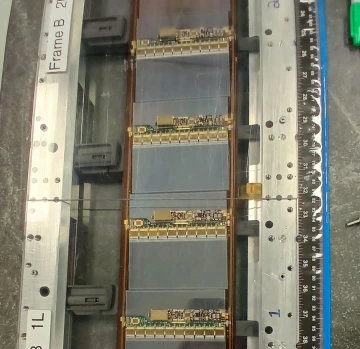
Diptiman’s daily work at BNL involves quality control testing of the Barrel Strip modules.
One of the most important and complex upgrades is the new Inner Tracker (ITk). The ITk will consist of an Inner Silicon Pixel Detector and an Outer Silicon Strip Detector. Together they will comprise nearly 200 m^2 of silicon detectors and over 5 billion channels of electronics! Data from the detectors is readout at 1 MHz, corresponding to a data output of 50 Tb/s. The ITk is used to measure the position and momentum of charged particles produced in the collisions. The position resolution is 7 um in the silicon pixel detectors and 25 um in the silicon strip detectors.
Two programs to inspire and train the next generation of physicists are sponsored by US ATLAS: ATC and SUPER, both of which are highly competitive. Diptiman Bora, wrote a winning ATC proposal to work with Dr. Ang Li of BNL. The primary tasks were related to testing the ITk silicon strip sensor devices and electronics. The award supported Diptiman for two months at BNL, located on Long Island. Diptiman had previous experience with the ATLAS experiment, working with Dr. Ken Johns on machine learning algorithms to separate BSM long-lived particles from backgrounds.
Diptiman’s daily work at BNL involves quality control testing of the Barrel Strip modules sourced from the Santa Cruz Institute for Particle Physics (SCIPP), Lawrence Berkeley National Laboratory (LBNL), and BNL itself. Initially, all silicon sensors and modules undergo visual inspections to check for scratches in the silicon or broken wire bonds. Modules received from SCIPP and LBNL are then subjected to intensive reception testing, which includes current-voltage (IV) scans and electrical evaluations of noise and gain plots to pinpoint discrepancies such as ineffective channels.
The in-house developed components from BNL require an even more extensive procedure. Because these modules are constructed by gluing power boards and hybrids, which contain read-out chips, onto the silicon sensors, baseline tests on the power boards, hybrids and the sensors are necessary prior to assembly. After the gluing process is complete, electrical tests are performed along with thermal cycling on the fully assembled modules to expose and identify any structural or electronic weaknesses.
BNL is responsible for assembling and testing half of the Barrel Strip modules used in the ITk, which amounts to around 6000 modules. The other half of the ITk Barrel Strip modules are being assembled in the UK. The ITk is set to be assembled and installed in ATLAS by 2029.
Diptiman reflects on his experience at BNL
What did you learn from your experience?
I learned how much rigorous testing goes into building large detectors for large collaborations. Working on the ATLAS Inner Tracker (ITk) upgrade introduced me to the hardware side, such as running IV scans, noise plots, and working with sensor electronics, giving me a much deeper appreciation for the level of precision required before components even reach CERN. I also gained experience in engineering solutions such as monitoring systems and data pipeline tools, while learning how to collaborate alongside so many scientists and interns on Earth’s biggest experiment.
What was the most difficult part of your experience?
Being in such an open, collaborative environment was a first for me. Initially, the most difficult part was navigating the downtime between module testing cycles. I took the initiative to ask staff scientists for extra work, and they were more than happy to assign me additional projects. This led me to design and develop a Raspberry Pi coolant leakage monitoring system for the stave testing enclosure. I also maintained the BNL Uploader, an automation tool for streamlining test data into the database. Overcoming that initial hurdle of asking, turned out to be the most educational part of my summer.
How did you enjoy working at BNL?
I’d never been to a national lab before, so visiting Brookhaven was wonderful. Getting to work directly on hardware for the HiLumi LHC upgrade and knowing my efforts directly helped CERN was amazing. I appreciated the opportunity to collaborate with fellow interns and staff scientists without any bureaucratic hurdles, and I loved the warm working environment, group lunches, and awesome people. Outside the lab, I loved spending time exploring Long Island and the city with fellow interns on beach trips, hikes, and weekend trips nearby.