


UA Physics Celebrates Nobel Prize with IceCube Panel Discussion
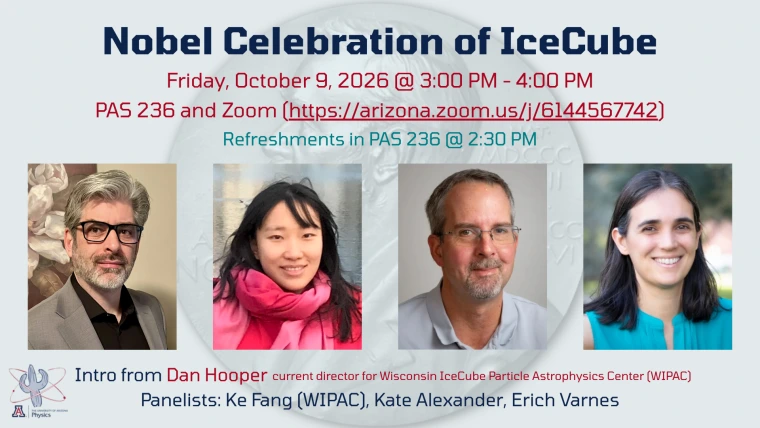
The University of Arizona Department of Physics hosted a celebratory panel discussion on October 9, Friday afternoon to mark the 2026 Nobel Prize in Physics, bringing together researchers from UA and the Wisconsin IceCube Particle Astrophysics Center (WIPAC) to reflect on the science and the scientist behind one of the most ambitious experiments in the history of physics. The event drew a standing-room-only crowd in PAS 236 — with many more joining live on Zoom — a turnout that spoke volumes about the excitement sweeping the physics community over the prize. The one-hour event gave physicists, astronomers, and students a rare chance to hear personal and scientific perspectives on the IceCube Neutrino Observatory and its landmark achievements in detecting high-energy neutrinos from deep space.
Dan Hooper, Director of WIPAC at the University of Wisconsin–Madison, opened the discussion with a reflection on the broader significance of the Nobel recognition and the man at the center of it. Joining remotely from Wisconsin, Hooper spoke warmly about his mentor, Francis Halzen — this year's Nobel laureate and principal investigator of IceCube who transformed neutrino astronomy from a theoretical dream into experimental reality.
Hooper recalled that his relationship with Halzen began even before he officially enrolled in his PhD program at Madison. The summer before his graduate studies, Halzen took him under his wing and set the course of his scientific life. That early generosity, he noted, was not unusual. “Francis has been extraordinarily supportive — not only to me, but to everybody he encountered who was just authentically trying to do physics. He believes in the beauty of science and he thinks everyone who loves it as much as him should be able to pursue it.” His remarks painted a portrait of a scientist who leads by inspiration as much as by intellect.
Erich Varnes, a particle experimentalist in the UA Department of Physics, followed with a concise overview of what makes IceCube so remarkable. Neutrinos interact with matter so rarely that catching them requires an instrument of almost absurd scale — a cubic kilometer of Antarctic ice instrumented with more than 5,000 optical sensors buried deep beneath the South Pole. Varnes walked the audience through the fundamental physics of neutrino detection and the engineering ingenuity required to turn a frozen continent into the world’s largest particle telescope.
Ke Fang, a researcher at WIPAC joining from Wisconsin via Zoom, took the discussion deeper into IceCube’s headline results: the detection of high-energy astrophysical neutrinos carrying energies far beyond anything produced inside our own galaxy. Fang discussed the ongoing effort to trace these particles back to their cosmic origins, pointing to candidate sources such as active galactic nuclei and blazars where extreme conditions can accelerate particles to energies that dwarf even the most powerful human-made accelerators. Identifying where exactly these neutrinos come from remains one of the most tantalizing open problems in astrophysics, and IceCube sits at the frontier of that search.
Kate Alexander of the UA Department of Astronomy brought the panel to a close with a discussion of multi-messenger astronomy — the emerging field that combines signals from gravitational waves, electromagnetic radiation, and now high-energy neutrinos to build a richer picture of violent cosmic events. Neutrinos carry information that light cannot: they escape environments too dense or energetic for photons and travel across the universe without deflection by magnetic fields. Alexander’s talk underscored why IceCube’s results matter far beyond particle physics, and why the future of astrophysics likely belongs to observatories that listen in every messenger at once.
A lively question-and-answer session followed, with audience members engaging the panelists on topics ranging from the practicalities of drilling into Antarctic ice to the future of multi-messenger observatories.
The event was organized in an intentionally relaxed spirit, and that informality lent the afternoon a warmth that matched the occasion. The Nobel Prize, after all, is not only a recognition of a scientific result; it is a recognition of a community of researchers, students, and collaborators who have spent decades building something extraordinary, one instrument and one discovery at a time. For the many students packed into PAS 236 on Friday, the afternoon offered something rare: a chance to hear, in personal and accessible terms, how transformative science actually happens — not in a single flash of inspiration, but over decades of collaboration, mentorship, and the willingness to build something no one has ever built before.
A full recording of the panel is available on YouTube: Nobel Celebration of IceCube — UA Physics Panel Discussion


