


Ali Habiboglu Receives Neil Smith Award at TMRC 2026
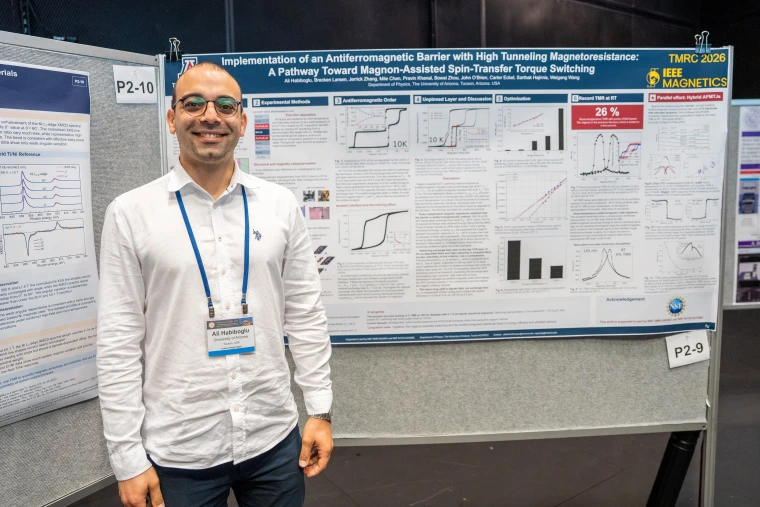
Ali Habiboglu's Breakthrough Antiferromagnetic Tunnel Junction Research Receives Neil Smith Award at TMRC 2026
A breakthrough in magnetic tunnel junctions (MTJs) with antiferromagnetic barriers has received the IEEE Neil Smith Award for Contributions to the Understanding of Magnetic Phenomena in Materials and Devices at the 37th Magnetic Recording Conference (TMRC 2026). The findings were presented by Dr. Ali Taha Habiboglu from Professor Weigang Wang's group. His poster, "Implementation of antiferromagnetic barrier with high tunneling magnetoresistance: a pathway toward magnon-assisted spin-transfer torque switching," demonstrated an important experimental advance toward a new approach for energy-efficient magnetic memory.
As artificial intelligence (AI) workloads rapidly increase computing and data-storage demands, the power consumption and thermal management of data centers have become major technological challenges. Magnetic tunnel junctions—the core elements of magnetic random-access memory (MRAM)—provide nonvolatile data storage with low standby power, but further reducing the energy required to write information remains an important goal for future high-density memory and computing. One promising approach is to use magnons—the collective excitations of electron spins—to transport spin angular momentum and assist magnetic switching. In conventional MTJs, tunneling electrons inevitably generate heat. Although the resulting temperature difference across a tunnel barrier may be only a fraction of a kelvin to approximately one kelvin, the barrier itself is only about one nanometer thick, producing a remarkably large temperature gradient at the nanoscale.

Theoretical work by Professor Shufeng Zhang's group proposed that this otherwise wasted heat could be put to work. In an MTJ containing an antiferromagnetic barrier, the temperature gradient can generate a magnon-mediated spin current, providing additional spin angular momentum to assist the switching of the magnetic electrode. This mechanism offers the intriguing possibility of recovering energy that would otherwise be dissipated as heat and using it as part of the device's operation.
A major obstacle to realizing this concept experimentally has been the fabrication of high-quality MTJs with antiferromagnetic tunnel barriers. Achieving strong tunneling magnetoresistance (TMR) in these structures, particularly at room temperature, has remained a significant experimental challenge. Habiboglu developed a specialized fabrication approach that enabled record-high room-temperature tunneling magnetoresistance in MTJs incorporating an antiferromagnetic barrier, establishing an important device platform for investigating magnon-assisted spin-transfer-torque switching. The achievement represents an important step toward connecting a compelling theoretical concept with experimentally realizable devices. Rather than treating heat generated during electrical operation solely as an unavoidable loss, this approach seeks to transform part of that dissipated energy into a useful source of spin angular momentum.
As the density and thermal demands of data storage continue to increase, technologies that recover rather than merely tolerate dissipated energy could become increasingly important. Habiboglu's demonstration of high-performance antiferromagnetic-barrier MTJs provides a key experimental foundation for a new class of memory devices in which one of the most persistent sources of inefficiency—waste heat—could instead become part of the switching mechanism.